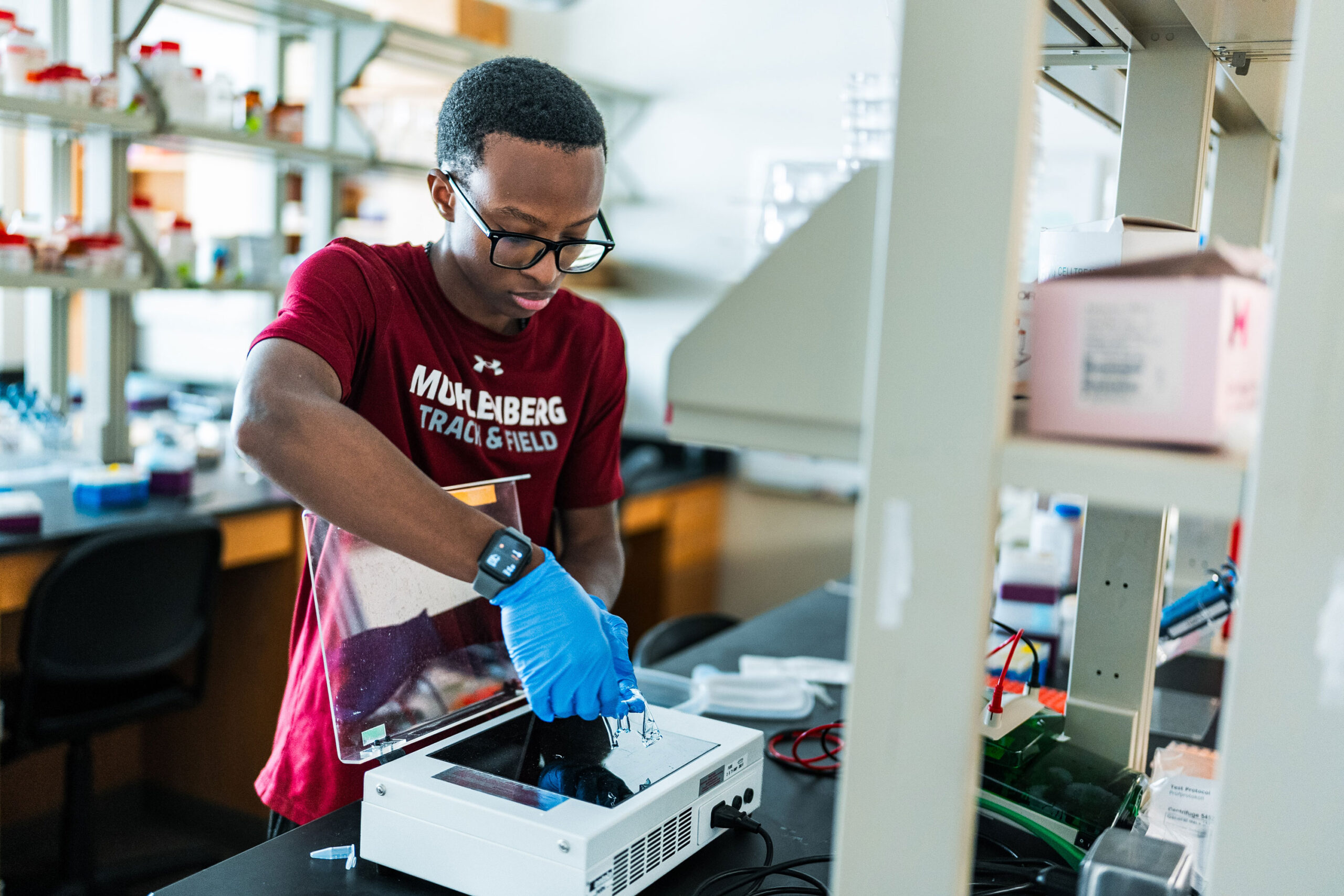
This summer, James Williams ’28, a pre-health biology major from Westchester County, New York, who’s also a student-athlete on the track and field team, is conducting summer research on campus. He is introducing stressors to a species of algae to see if it reacts similarly to or differently from how a terrestrial plant would react.
Why did you decide to pursue summer research?
My research experience started when I was in high school. I did an ecology research program at the Bronx Zoo in my junior year going into my senior year. And I was really interested in learning more and just building my experience. I reached out to my professor [Assistant Professor of Biochemistry Josephine LoRicco] in my sophomore year and I saw what their research was about and I told them I was really interested in what they’re doing and I wanted to help them with their project.
A lot of the work that I’ve done in the lab sections for my biology and chemistry classes, a lot of the techniques that I learned in those labs, I’ve been able to apply to this research.
What does your project entail?
I read a few research papers, and I was able to make my own research plan on how I want to transform the algae and express certain things. So what I’m doing in the lab personally is I’m using a machine called electroporator, which basically shocks whatever I put into it with plasma DNA, and then it will transform that organism to express that gene. I’m trying to transform this species of bacteria called agrobacterium. It’s primarily found infecting terrestrial plants. I’m using the electroporator to shock the bacteria so that it can express whatever genes that I decide to mix into it. And then I would use that agrobacterium to see if it infects the algae the same way as it does like a land plant.
How have your Muhlenberg experiences helped you in this work?
A lot of the work that I’ve done in the lab sections for my biology and chemistry classes, a lot of the techniques that I learned in those labs, I’ve been able to apply to this research. I’ve been able to apply that and then learn more from my professor, which should set me up for the next two years, especially because I’m taking Organic Chemistry and different biology courses.