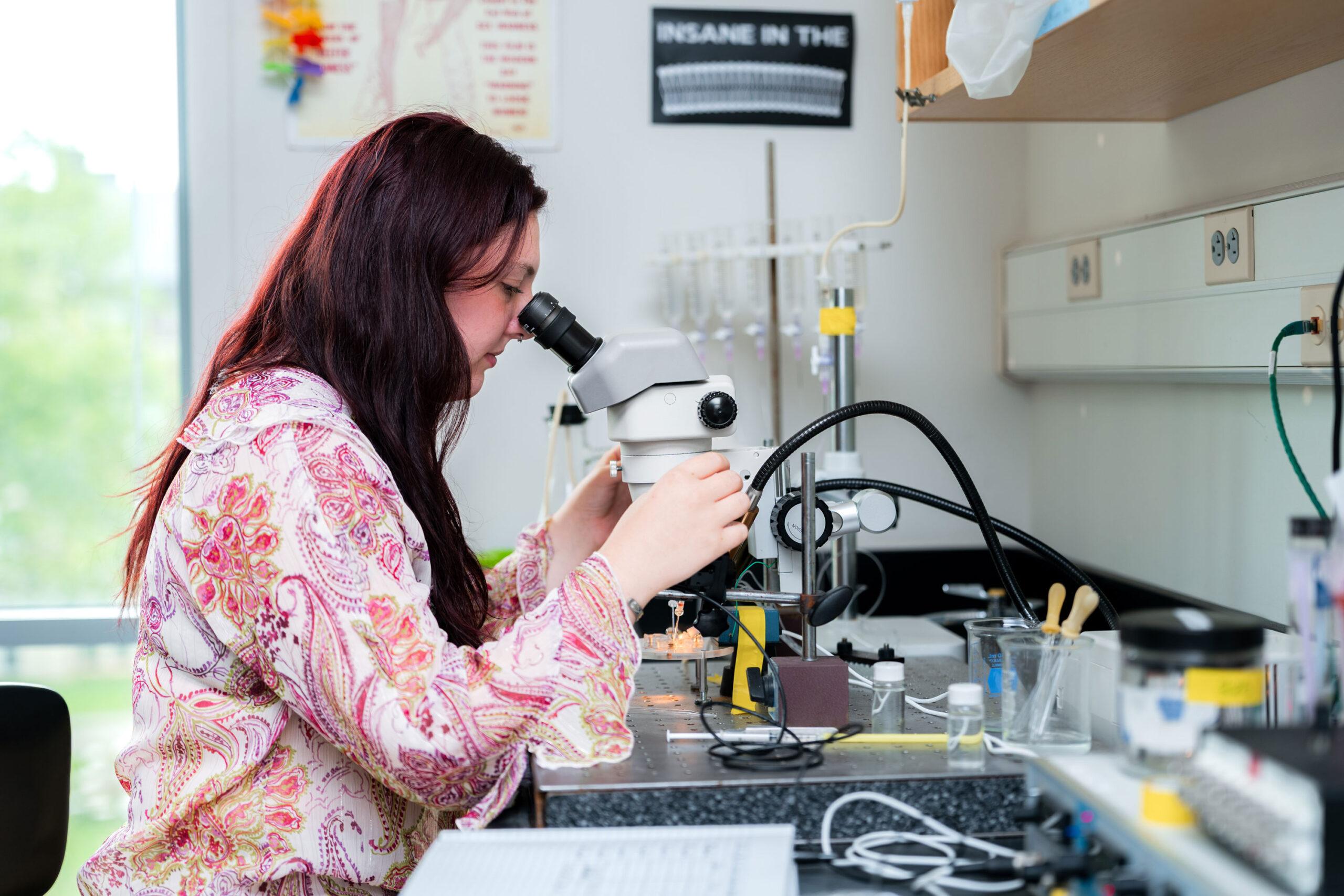
This summer, Hannah Spence ’27, a neuroscience major from Center Valley, Pennsylvania, is conducting research on ashwagandha and GABA receptors with Stanley Road Professor of Neuroscience Jeremy Teissere.
Why did you decide to pursue this summer research project?
The Teissere lab is invested in researching naturally occurring substances that can be alternatives to synthetically made pharmaceuticals. I wanted to pursue neuroscience research on ashwagandha and GABA receptors this summer because I am interested in the social implications of this knowledge. As a student invested in pharmacology and psychology who has lived with anxiety and depression disorders throughout my life, researching how ashwagandha can help reduce symptoms was a key focus and driving factor of my research. Knowing how ashwagandha works and where it works is crucial to understanding how to use it in a safe and effective manner, both inside the clinic and out.
My coursework has provided a strong foundation for my summer research. Classes such as From Organisms to Molecules, Neuropharmacology and Cell Signaling, and Neurons and Networks provided me with essential lab techniques and a deep understanding of cellular mechanics as well as molecular and drug interactions.
What does a typical day look like for you?
My typical day runs from 9 a.m. to 4 p.m., beginning with a briefing from Dr. Teissere. Our molecular work is varied: We might develop cell stocks, isolate plasmids for specific receptor subunits, or synthesize RNA. We also conduct carefully managed procedures to collect eggs from frogs, ensuring they remain comfortable and well cared for throughout the recovery process. These eggs are then injected with our synthesized RNA, allowing us to record and analyze electrical responses when exposed to various compounds. Part of my work this summer has focused on creating my own extract from ashwagandha root powder rather than using a commercially available extract. Although the process was both challenging and rewarding, I successfully produced an extract with a promising concentration.
How have your previous Muhlenberg experiences helped you in this work?
My coursework has provided a strong foundation for my summer research. Classes such as From Organisms to Molecules, Neuropharmacology and Cell Signaling, and Neurons and Networks provided me with essential lab techniques and a deep understanding of cellular mechanics as well as molecular and drug interactions. These academic experiences have been vital in allowing me to continue learning and growing throughout my research project. Dr. Teissere taught me all of the molecular techniques needed to diagnose our DNA and RNA, collect the frog eggs, and work at the rig to record electrical currents coming from frog eggs.