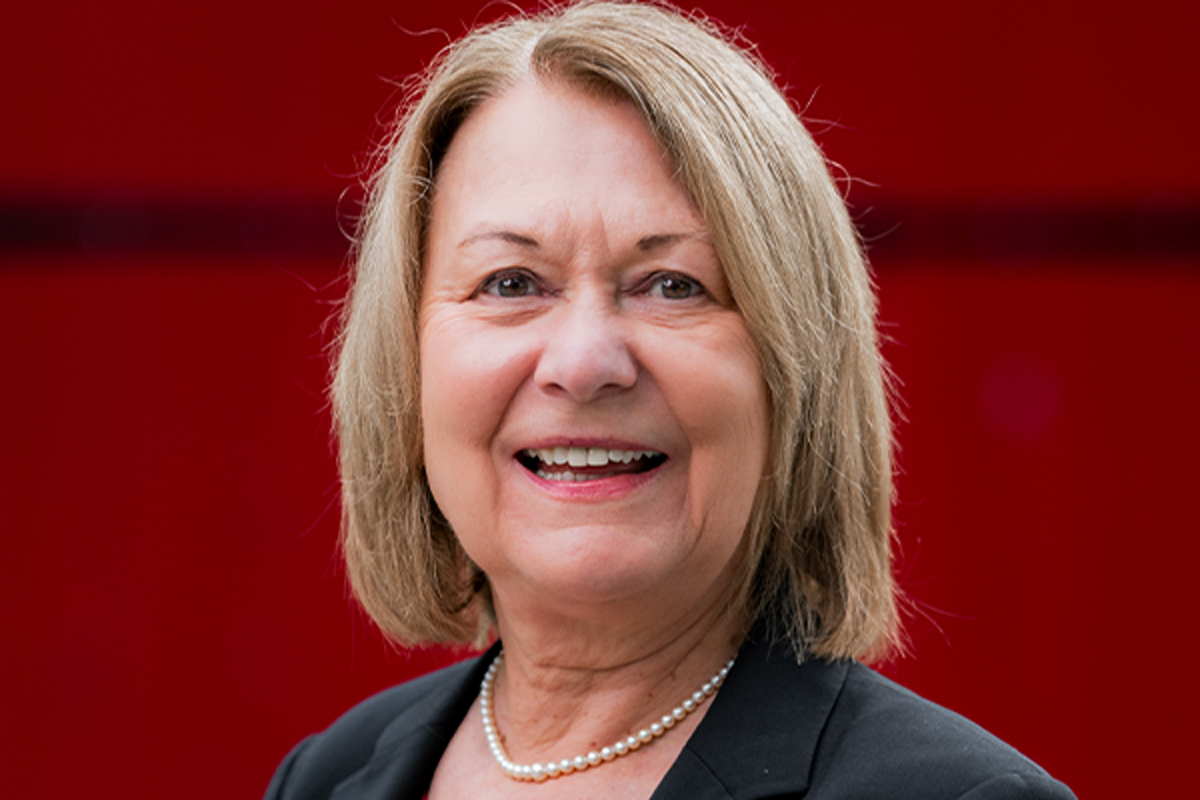
Delivered October 17, 2026 by President Kathleen E. Harring, Ph.D.
Good morning! It is wonderful to see you on campus. There are few more beautiful times to be at Muhlenberg than autumn, so I’d like to begin with a few lines from a poem by one of our students, Ruby Sinder, an English and Creative Writing major in the Class of 2028. It’s called “Fall Fell At Our Feet,” and it was published in The Muhlenberg Weekly in 2024, when Ruby was a first-year student.
Ruby writes:
I could get used to the neatly shaped grass
That lines the walking paths
The path to the building
With the rug wrapped in leaves
Brown and crunched
Yet can finally breathe
The breath of fall that was gifted to me
Whether you’re here as an alum, a student, a member of a student’s family, or for some other reason entirely, I hope you’ll pause and appreciate the sense of place — and the sense of peace — that our campus offers at this time of year.
This is a very human place and a very humane place. It’s a place where we challenge our students to think deeply, where we help them feel safe in themselves, and where we give them a supportive intellectual community. It’s a launching pad from which they can engage the world fearlessly and from a place of integrity. It is the antidote to a short-attention-span world that runs on digital devices.
Places like this are increasingly rare, and the truth is that colleges like ours are swimming upstream. The population of the northeastern United States is declining. People are asking hard questions about the value of a college education and of the liberal arts in particular. Fewer families believe they can afford it.
But I would argue that the world needs Muhlenberg and places like it more than ever. We have an important role to play.
Here’s the good news. We are working hard to fortify and sustain Muhlenberg for the long term. And, in spite of a challenging environment, the state of our college is strong.
Muhlenberg is financially stable and well resourced. This year we earned an A+ on the 2026 Forbes College Financial Grades report, an independent assessment of the financial health of colleges and universities across the country.
Our endowment is valued at more than $400 million, and its proceeds make up about 15% of our operating budget every year, through endowed scholarships, professorships, and programming. We are fortunate that the college’s leadership over many years has had the forethought to build that endowment, and we’re fortunate to have alumni and donors whose generosity makes such a difference here.
That said, you’ve surely heard in the media and elsewhere that many colleges, perhaps most, face a fluid financial picture. There are far, far fewer college students nationwide than there were 15 years ago, and not nearly so many of them live in the Northeast. Our biggest recruiting territories are in Pennsylvania, New Jersey, and New York.
Even so, our recruitment efforts paid off and I’m glad to report that we met our enrollment goal for this fall. But our enrollment goals are smaller than they were a decade ago, and many of our students are able to pay less. Because of these shifts, we will need to adjust for the foreseeable future.
Getting there has required making some hard decisions. Like many colleges and universities, we have been running an operating budget deficit since the pandemic. We’re fortunate to have the resources to weather it, but obviously we need a balanced budget. In spring 2026, we announced a three-part strategy to assure a balanced budget and sustainable operations going forward.
None of it is surprising: reducing costs and diversifying revenue, program growth, and improving efficiency and governance. We restructured staffing and the budget last year and are continuing to work on efficiency measures and program development. We’ll see the results over this year and next.
All of these changes underscore the value of our community and everything you do to support the college and our students. In a challenging environment, the difference between success and failure often is our endowment and the philanthropy that funds it.
In the summer of 2025, we completed the Boundless campaign — the most successful fundraising campaign in Muhlenberg’s history — which raised more than $127 million over seven years. And in the fiscal year that ended June 30, you, our community, helped set another record, about $28 million in philanthropy.
I hope you are as proud as I am. Because, the truth of the matter is that it is philanthropy that will sustain our model of higher education through challenging times.
It also is an investment in our values.
The Boundless campaign focused on providing talented students access to a Muhlenberg education — not just in the classroom but also through experiential learning opportunities like study abroad and internships. It focused on recruiting and retaining great faculty through endowed professorships. And it has provided for the ongoing improvement of our first-rate campus, including the construction of the Fahy Commons for Public Engagement and Innovation and the renovation and expansion of Seegers Union — the Gateway at Fahy Pavilion, which is slated to open in the spring semester.
But at the end of the day, it’s all about our students, what we help them achieve, and the impact they make — both while they’re here and after they graduate.
One of the things I’m most excited about in the Fahy Pavilion is the new combined Center for Career and Global Engagement that will be on the second floor. It will bring together so much of what we do to launch our students and focus them outward — on making that impact on the world beyond the edge of campus. Internships, study abroad and away, graduate and professional school, their eventual career… We’re putting all of it in one place.
The center has a great team, and they partner with faculty, alumni, businesses, and organizations to come up with a lot of innovative programming. Career coaching from the moment students arrive on campus. Career road trips that expose students to industries and organizations throughout the mid-Atlantic. Pre-health advising that challenges students to go above and beyond in their quest for admission to dental and medical school.
Opportunities to do intensive short-term experiences in places like Morocco and Costa Rica as well as traditional study-abroad experiences in places like Australia, Italy, Spain, Brazil, or South Africa, or study-away programs in this country — Washington DC or New York City and many other sites.
I want to remind you, though, that we’ve always been good at this. We’ve been adapting year over year so that we are launching our students into careers that meet the needs of the moment. There’s no better measure than their success. Within 15 years of graduating, our alumni rank in the top 20 percent nationally for return on investment, and in the top 10 percent within 20 years. That’s according to a Georgetown University study done last year. For the Class of 2025, 95.6 percent of our graduates were employed or in graduate or professional school within six months of graduating. Our placement rates for medical school, dental school, and law school are all above 90 percent.
It’s incredibly fascinating to see where our students end up. It’s rewarding to watch brilliant students fulfill their potential in elite fields and to celebrate their accomplishments.
Last year’s SGA president, Sabeen Safi, was brilliant and driven. This year, she is a student at Penn Dental, where we have a cooperative program.
On her way there, Sabeen achieved everything she possibly could on campus. One of the more impressive things: As a researcher in Professor Giancarlo Cuadra’s lab, she investigated the impact of vaping on the oral microbiome. She and her research group were funded by Muhlenberg to present their findings at an international conference in Barcelona in summer of 2025. In addition to her research, as student government president, she worked to facilitate constructive dialogue across campus.
I think that the multifaceted approach to life on campus and academics really breeds a special, entrepreneurial spirit in a lot of our students and alumni.
We recently featured two alumni, Matt Solnick Class of 2019 and Jacob Wahba, class of 2020, who run a video-production company in New York. Since graduating, they’ve been collaborating on video and social media for brands like Nike and Dior. Recently they shot a series of advertisements for B&H photo, a big New York photography equipment retailer, featuring Tony Dalton, who works in our Media and Communication department. You can see them in action on our YouTube channel.
And last year one of our honorary degree recipients was Zachary Mannheimer, class of 1999. In 2020, Zach launched his company, Alquist 3D, which prints concrete commercial and residential buildings, including the first 3D-printed home to be owner-occupied. He’s working to spread the model as a way to address the national housing crisis, and his company is moving rapidly into large-scale commercial work.
So, what did Zack major in? Philosophy and theatre.
After graduating from Muhlenberg, Zack directed and produced theatre for 10 years in London and New York. He then established a nonprofit cultural and arts center. Following that, he launched a company that helped small towns create art spaces, breweries and other businesses. That endeavor expanded into city planning and eventually the founding of Alquist 3D.
Zack’s successes are concrete evidence that you can do anything with a Muhlenberg liberal arts degree.
Others are noticing Muhlenberg’s success. U.S. News ranks us 62nd among 203 national liberal arts colleges, our highest ranking on record. That’s up from 70th last year. Our previous high was 64th in 2015. We’re 59th in the new ranking of top private national liberal arts colleges.
The Princeton Review named us among its Best 392 Colleges nationally as well as its Best Mid-Atlantic Colleges, and also ranked us fifth in the nation for theater. In the inaugural TIME “America’s Best Colleges” list, which prioritizes long-term success, we placed 198th out of 500. Washington Monthly ranked us 163rd nationally and 49th in the Northeast among colleges that deliver the most for tuition and tax dollars, with especially strong marks for outcomes. And Niche again ranks us 23rd in Pennsylvania and first in food.
There are many reasons you move up or down in the rankings, and it’s great to see US News and others beginning to give the outcomes of a college education more emphasis than they used to. US News used to be all about the inputs: how much money you have, standardized test scores, that sort of thing.
Now it’s more heavily weighted toward impact and success measures. And that is where Muhlenberg shines. That’s our special sauce.
To our alumni here today: You know this. You are the proof. Our alumni also know that one way we produce so many successful graduates is by understanding two things can be true at the same time. You can offer a college education that is grounded in the liberal arts and sciences — the fundamental disciplines and habits of minds that colleges like ours have been teaching for centuries — while at the same time continually evolving how students apply what they learn in the classroom and lab, onstage, or in the field. That’s how you produce results in talented, ambitious students who aren’t willing to settle.
So, we are continually updating our academics — our majors, minors, degrees, and credentials. In 2024 we launched a new general education curriculum called Pathways for Discovery. It takes students through seven broad content areas called the “Explore Core” to discover ways to think across disciplines and cultivate a lasting love of learning. Pathways for Discovery requires experiential learning — internships, research, immersive study-abroad opportunities, that sort of thing — so that our students can put their knowledge into action, now.
We’ve also developed several micro-credentials including Design for Performance, Cross-Cultural Competence, Literary Editing and Publishing, and Pharmaceutical Science. These are related groups of courses that cut across majors to give students a multidisciplinary understanding of a topic. Like what you do in professional life every day.
How many people here are familiar with our graduate programs? We launched our first graduate degree programs in 2020 and have been continuing to refine them ever since.
Recently we’ve been taking a look at what our community wants and updating the programs accordingly. This year we launched an MBA, and expanded it to a 4+1 program, so that current students can move straight into that if they qualify and have the drive. If you haven’t been in Ettinger Hall recently, stop by and take a look at the finance lab and the student business center. In addition to the MBA, we’ve had a 4+1 Master of Arts in Teaching program for a few years now, and the next step is a master’s in computer science.
This is all well and good, but it means nothing without the people — about the life-changing opportunities our students get here. So I want to share a story about one of our students, Melina Sarion, class of 2027.
She’s a math and computer science major and really is a great example of how our students put knowledge into action.
Over the summer, Melina worked with Professor Hamed Yaghoobian using a robot named Reachy to study human/AI interaction — how undergraduate students react to and alter their behavior in response to AI, and how they transmit human values and behavioral expectations to an AI-powered robot. She studied how undergraduates pass their values on to Reachy, and how they correct the robot when it gets something wrong. So, she really was working to answer a big question; when we interact with artificial intelligence, who is shaping whom? She wants to find out how we can help shape AI so that it benefits society rather than reflecting our worst instincts.
These are really big questions, and they’re the sort of thing that gets asked from the moment students arrive on campus. There’s a great video on our website, if you’d like to learn more.
Another really fun fact about Melina: She recently competed on the show “American Ninja Warrior” alongside her father. Keep an eye out for when the show airs!
We truly believe the most important questions deserve to be explored by students. Giving our students this mandate — giving them work this sophisticated requires coaching and mentoring. And we have a culture of coaching here at Muhlenberg. Melina is a brilliant student whose work has been enabled by Dr. Yaghoobian, but our students don’t have to wait to be seniors to have this kind of mentorship. Many of you probably know this already; every student here has several coaches from the minute they arrive on campus. It’s the difference between admitting talented students and watching them respond to what’s around them and admitting talented students and challenging them to excel beyond what they thought possible.
Our culture of coaching has been a strength of ours for an awfully long time, and it plays out in all sorts of ways, like Melina’s work with Professor Yaghoobian. A few years ago we decided to formalize it, and today every new student gets three coaches to help them maximize their potential — their academic advisor, of course; a career coach — in the career center — to help them think long-term; and a college-life coach to help them take advantage of as many opportunities as possible on campus and give them advice in navigating challenges. We all know that top performers, whether they’re athletes, executives, performers, or anyone really, use coaches to push themselves toward excellence. We’re using that model for the benefit of our students.
Speaking of coaching and excellence, I want to talk about two more ways our students are doing hands-on learning: athletics and the arts.
I’m so proud of our student-athletes and want to lift up our softball team. Two years ago, the 2025 team went 21 and 20 — good, but not world-beating. This past spring our 2026 team improved to 36 and 13, the biggest single-year jump in program history. They won the most games of any Muhlenberg team in any sport in any single season — ever. They finished ranked 15th nationally, the highest ever for a Centennial Conference softball team.
That doesn’t happen by accident. I wasn’t there for every game or practice, but I do know that success like this comes from the cumulative effect of doing hundreds, probably thousands of small things right every single day. It’s about discipline and teamwork — grinding away, getting the small things right, and intentionally building relationships.
And doing it all while balancing full courseloads and other obligations on campus and off. If that’s not experiential learning, I don’t know what is.
Being a student-athlete is formative. It shapes how you approach professional life, friendships, and communities. It makes you synthesize a wide variety of skills in order to produce a winning product. Honestly, it’s like pursuing a microcredential.
Everything I just said about student-athletes applies also to the performing arts. People don’t often talk about these two areas of college life at the same time. And it’s almost impossible to do both in most colleges and universities. But one thing that I love about Muhlenberg is how these things have similar weight on campus and complement each other — one on the north side of campus and one on the south side, no less.
By the way, if you have not seen our new softball field, right next to Scotty Wood Stadium, go take a look. It’s beautiful, and I had the privilege of throwing out the first pitch there last spring. And on the south side of campus we’re celebrating the 50th anniversary of the opening of the Baker Center for the Arts. What a history that place has!
Here’s an update on a few things happening in Theatre and Dance, which — I’ll repeat it — was ranked 5th in the nation by Princeton Review. We’re proud of that, but the big news is that we will be launching a musical theatre major soon. This past summer we offered an updated version of summer musical theatre for the first time since before the pandemic. The production this year was Seussical, and it had a great run. As part of the production, we hosted a Seussical camp for middle school students. Our students helped put it on, and it attracted a ton of young people from the area. The next production, in a few short weeks, is Carrie: The Musical. We are about to find out how frightening musical theater actually can be.
And, at noon today, be sure to attend the choral concert in Egner chapel. Alumni, I know you will remember how amazing the acoustics are in the chapel. Rest assured that it’s still gorgeous.
I’m often asked about the future of the liberal arts in an age of rapid change — the age of AI. Machines are taking on human characteristics and doing human-like things in ways they never have before. That is altering whole professions and changing society profoundly, not always for the better.
But we are a liberal arts college, the most humanistic form of higher education there is. We are descended from the great universities going back to the eleventh century and a product of the American Enlightenment. We are pretty savvy with technology, but at our core, there is no more analog place than what we do here.
That matters because liberal arts colleges are here to better their students and the world. We play a critical role in American democracy because we come from the same philosophical roots. We are protectors of essential liberties — freedom of expression, inquiry, and assembly, and they are grounded in empirical thought and reason. Most of all, we are premised on an engaged citizenry, people who advance society through public involvement in things that matter.
I will conclude by noting this. Our intellectual heritage is in the American Enlightenment. And our values — our humanity — are rooted in the college’s Lutheran underpinnings:
Meaningful vocation: exploring and discerning your calling, growing into a more complete person, and making the world better through your work.
Shared responsibility: showing one another the care every person deserves, and serving society with that care in mind.
Human flourishing: encouraging ourselves and each other to become the best versions of who we are, and helping others flourish too.
That is who we are and what we believe, and that it is why the state of our college is strong.
I want to end with a video where faculty, staff and students discuss our values. The work we’ve been doing to lift up our distinctive culture was supported by an external grant aimed at exploring our institutional legacy – past, present and future. This video is one outcome of the Red Door Roots project. It seems fitting to showcase it more publicly during the College’s inaugural Red Door Weekend.
Thank you for being part of the Muhlenberg family. I hope you enjoy all the events and activities we have in store for you during this weekend.