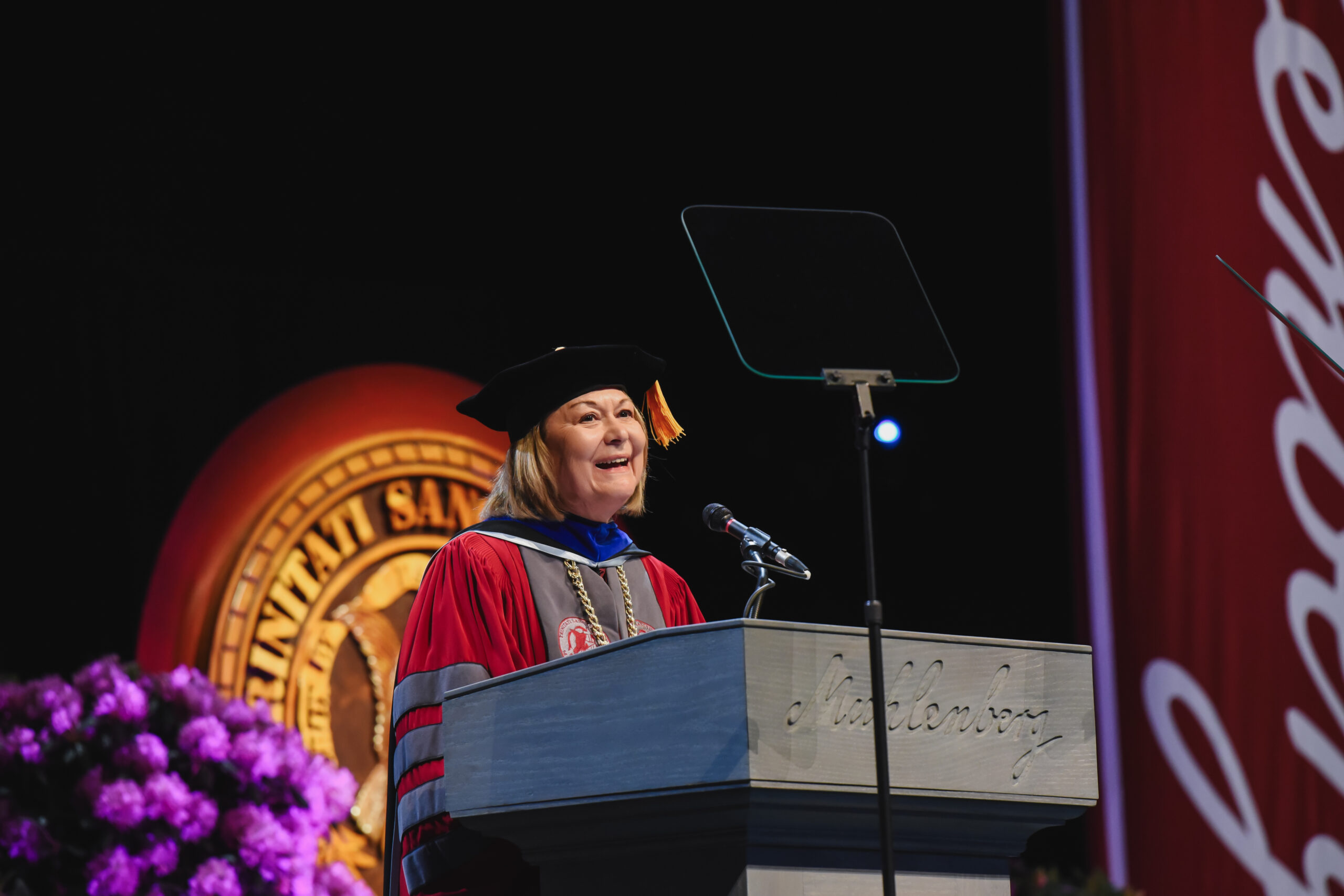
Families, friends, faculty, staff, trustees, and distinguished guests — thank you for joining us today to honor our graduates.
Muhlenberg Class of 2026, congratulations. We are very proud of you.
Graduates, this is a historic year for you. It’s also a historic year for our country — a big anniversary. 250 years ago, in 1776, delegates to the Second Continental Congress were in Philadelphia. There, they debated and refined one of the most consequential documents in the history of the world — the Declaration of Independence.
It was a hot, humid summer, and the delegates kept the doors and windows closed in the interest of secrecy. John Adams described the experience as “parching under the fierce heat of dog days.”
Nonetheless, they made pivotal decisions that defined their future and ours. They set down fundamental truths — unalienable rights — on which to build a nation. They were imperfect human beings and products of their time, but they did hard things and took big risks in service to the common good.
Your alma mater, Muhlenberg College, was founded 72 years after the signing of the Declaration, and it was named in honor of Henry Melchior Muhlenberg, a key figure in colonial America. He, too, did hard things in service to a brighter future.
A minister and an immigrant from Lower Saxony, in what is now Germany, Muhlenberg led the establishment and growth of the Lutheran Church in America, ministering and caring for thousands. He was a religious leader and organizer who took action in very real ways to improve the world around him.
By the time Thomas Jefferson, Benjamin Franklin, and John Adams were meeting in Philadelphia, he had retired to his home in Trappe, Pennsylvania, about 40 miles south of here.
I don’t know if Henry and his wife, Anna Maria, were trying to create an American dynasty that would lead and serve in our fledgling democracy — but they certainly gave it their best shot as parents of 11 children including the nation’s first speaker of the U.S. House of Representatives, a world-renowned botanist who also was a college president, and a famous revolutionary war general, General Peter Gabriel Muhlenberg.
In 1776, Peter Gabriel Muhlenberg, like our country — was at a pivotal moment. He was pastor serving both English and German parishioners in the Shenandoah Valley of Virginia. A man of deep faith, but also an early patriot, an outdoorsman with a fierce drive, and a complicated legacy.
As the story goes, on January 21, 1776, during Sunday services, he read from Ecclesiastes: “To every thing there is a season, and a time to every purpose under the heavens… a time of war, and a time of peace.” Then he looked up at his congregation and said: “And this is the time of war.” In the apocryphal story, he then shed his robes to reveal a military uniform underneath.
Peter served as general in the Continental Army, fighting at Brandywine, Germantown, and Yorktown. Later, he served as a U.S. Congressman, and a U.S. Senator.
Like the signers of the Declaration, he made a pivotal decision that defined his life and ours — a big risk in service to a brighter future and the common good.
Your liberal arts education means freedom — the freedom to think, to reason, and to act ethically. The freedom to transcend the trends and technologies that seem to define this moment. The freedom to understand your larger role and place in history.
Why all this history today?
First, because today, we still hold fast the ideals taught and lived by Henry Melchior Muhlenberg: human flourishing, social responsibility, and personal vocation — the belief that as you learn and grow, you are called to find your path in a way that betters the world.
Second, we steadfastly live and defend the ideals of the American Enlightenment that gave us the Declaration, the Constitution and, for that matter, the liberal arts — the emphasis on individual liberties and civic responsibility … on reason, critical thinking, empirical evidence, and effective communication.
Third, because today, you, too, are at a pivotal moment in your lives. It is time to decide how you will lead — and how you will serve.
My charge to you is this: consider your legacy and define for yourself how you will lead and serve.
Will you be like one of our honorary degree recipients?
Like Raj, who is a nationally recognized leader in civic engagement?
Like Kassie, who has brought the arts to millions in our community and beyond?
Like Zack, who has pioneered solutions to one of the biggest challenges our country is facing?
Or will you follow in the footsteps of the Muhlenbergs and serve in public life?
Only you know for sure what that will look like, but here is what you can be certain of.
Your Muhlenberg education means that you will flourish and find your vocation — continuing to grow, adapt, and evolve. It means you will do so with care for our world and for your fellow human beings.
Your liberal arts education means freedom — the freedom to think, to reason, and to act ethically. The freedom to transcend the trends and technologies that seem to define this moment. The freedom to understand your larger role and place in history.
And it means responsibility — using your talents for the betterment of the world.
To live the values you have cultivated here.
To be exactly what our world needs – extraordinary Mules.
Congratulations, Class of 2026. Now, go and change the world!