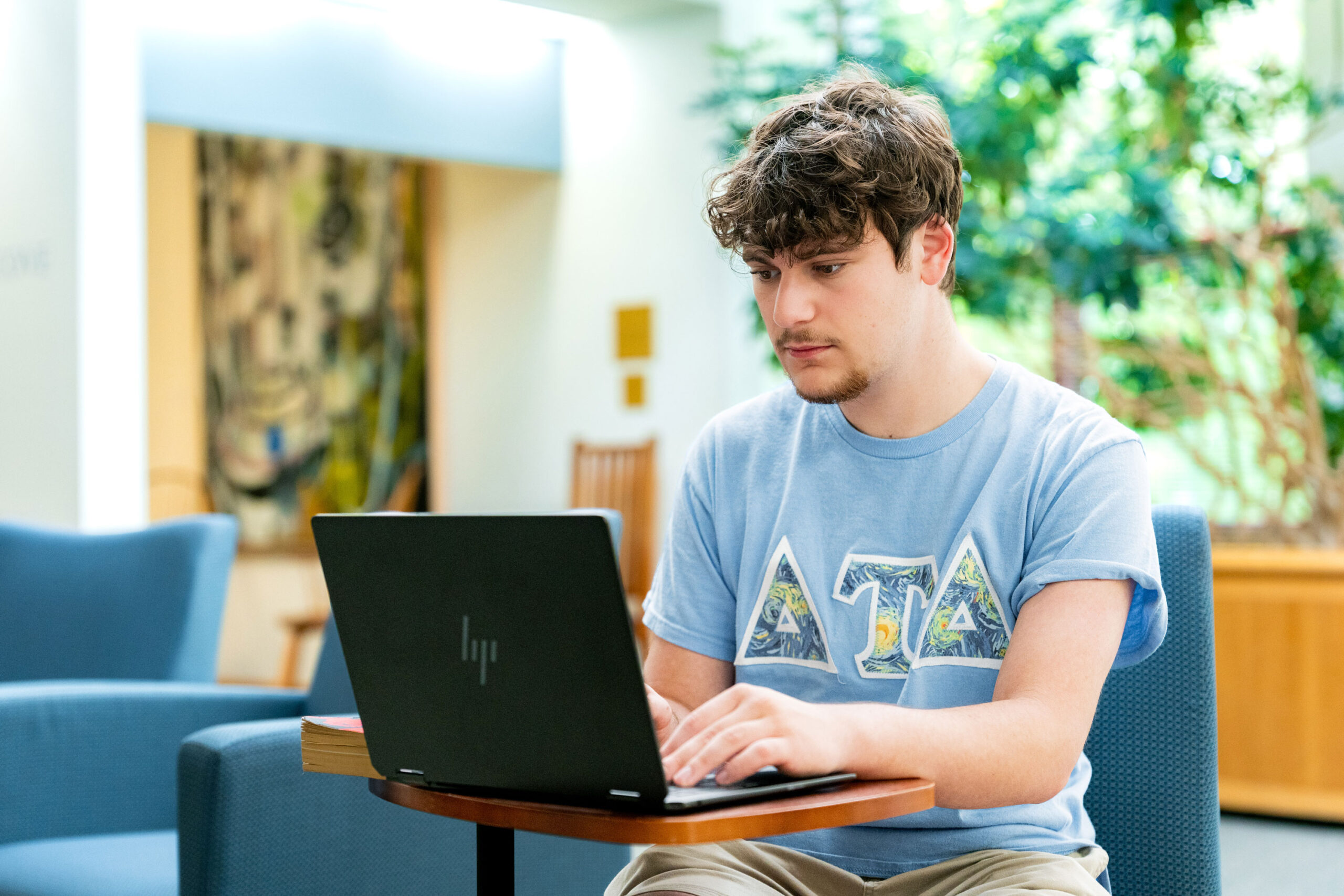
This summer, Ethan Ross ’29, a rising sophomore from Ocean Township, New Jersey, who’s interested in both neuroscience and film studies, is conducting eight weeks of summer research on campus. He is analyzing 12 psychological dramas made in four different countries — the United States, England, Japan, and South Korea — to explore their similarities and differences and how the films reflect the culture and period in history in which they were made.
Why did you decide to pursue this experience?
I love film overall and studying film in my free time, and I learned that I could do independent research doing essentially whatever I want to do. I thought that I could do something combining my interest in the sciences as well as my love for film. A neuroscience professor pointed me to [Associate Professor of Psychology Alexandra Frazer]. I went to talk to her and she told me about the independent research program over the summer and said that if I can come up with a good proposal, then I essentially was good to do whatever I wanted.
This is the learning experience. That’s actually the point of independent research — as long as you’re figuring out the process of research for yourself, then you’re doing your job.
What has this research experience looked like for you?
I spent the first couple of weeks watching films that I thought would be good for this project, taking notes on them, and finding some papers on them. And then once I had that stuff, I looked at all 12 and I looked at my countries and I kept reading more and more papers. Essentially the first five weeks of what I was doing was reading papers, but I ended up with a good body of evidence to work with. I was able to draw a lot of comparisons and identify some trends and patterns. Then, I started to synthesize my final poster presentation. I think I might end up writing a paper for publication. It’s not required, but I spoke to my old film professor [Director of Film Studies Amy Corbin] and she said that it would be a good idea to just keep working on it and really solidify it. I would really love to put something out there because I’ve done a lot of work on this and I feel like I could probably end up writing a pretty good paper.
How have your Muhlenberg experiences helped you in this work?
Taking a film analysis course in my first semester taught me about just how analytical and almost scientific it is to be doing a project like this in film. I hadn’t really done any research yet, taking mainly intro courses. This is the learning experience. That’s actually the point of independent research — as long as you’re figuring out the process of research for yourself, then you’re doing your job. I felt a little like I was unguided and doing this on my own, and then Dr. Frazer was like, “Exactly. It’s what you’re supposed to be doing. Your eight weeks is for you to figure out what research is like.”