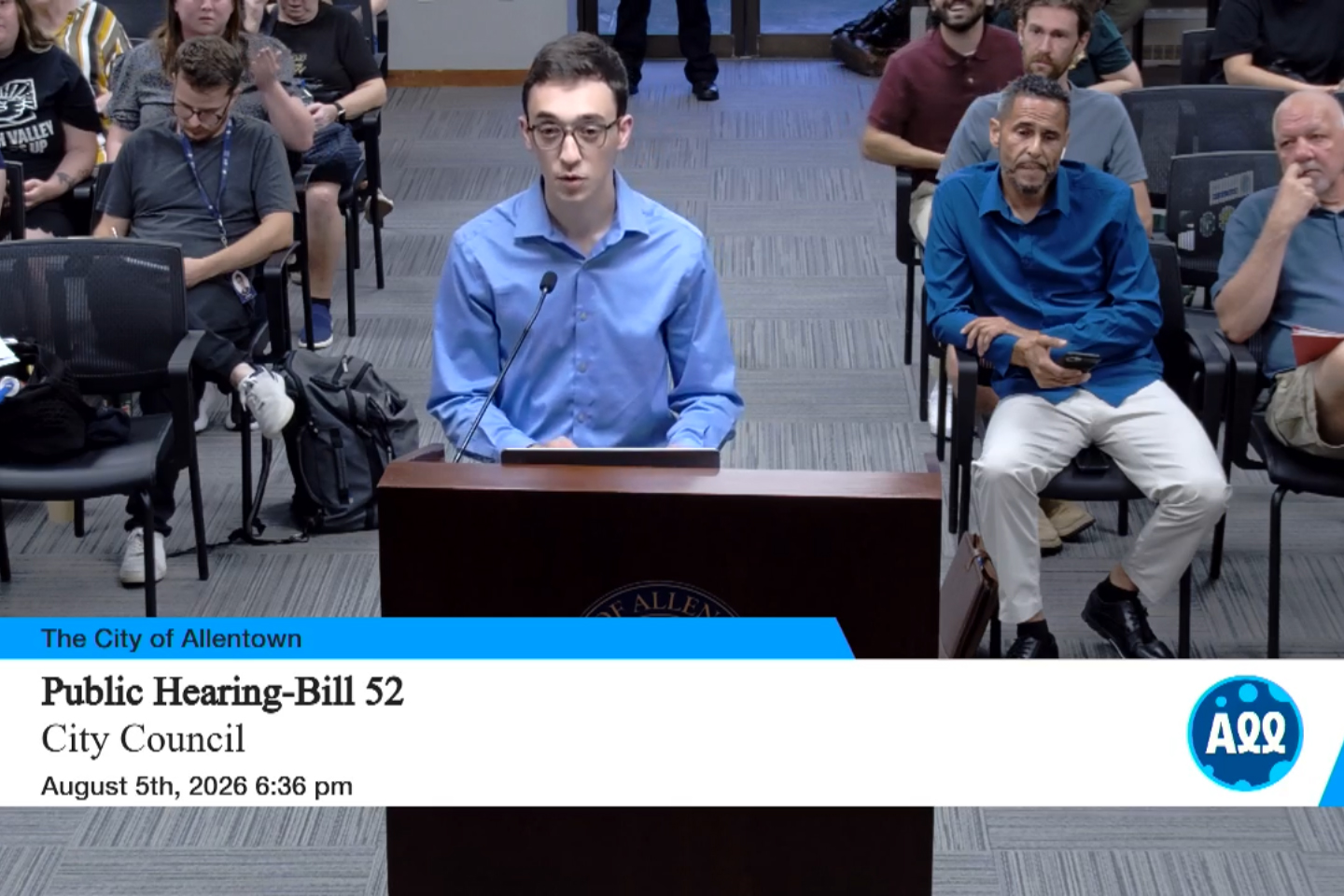
This summer, Noah Rosenfeld ’28, a statistics and psychology double major from Dallas, Texas, has an internship with the Allentown Environmental Advisory Council (AEAC). The experience is part of the Office of Community Engagement’s Community Internship Program, which offers grant-funded stipends to students interested in working with community organizations.
Why did you decide to intern with the Allentown Environmental Advisory Council?
I knew I was interested in a career related to research after conducting research with the psychology department. I then worked with the Career Center to narrow my focus, and through that process, I discovered I wanted to work somewhere within the political sphere. This past semester, I started working for the Muhlenberg College Institute of Public Opinion, where I affirmed I really enjoyed political research. However, through the Career Center, I also learned about careers in public policy, which may include a combination of research and problem-solving in the political sphere. When I read that the AEAC wanted an intern to conduct a research report on a topic relevant to sustainability and/or the environment in Allentown that could potentially influence city legislation, I knew the internship would be perfect for me.
[A class project] helped me gain experience conveying research through various means and for various audiences, which I directly applied when presenting my research to the Allentown City Council and members of the public.
What have you been working on during this internship?
My days have varied dramatically over the course of the summer, but they generally involve watching city meetings and going through city meeting materials.
Early in the summer, I did this to create an unofficial summary of public commentary surrounding a controversial bill in the city [relating to data centers], which the city reviewed when developing future amendments.
Later in the summer, I created a report that provides a chronological account of the city of Allentown’s actions related to data center legislation up to August 5. It also details recommendations for future amendments and ways to improve the city’s transparency and communication. In completing this report, I learned about all the steps the city needs to go through to pass various types of legislation, factors that limit the city when it provides legislation on data centers, the public’s general opinion on data centers, and the relationship between the city and the public on the issue. I presented a summary of this report to the Allentown City Council at a public hearing, and the full report will become publicly available soon on the AEAC website.
Aside from this, I spent a lot of time learning about data center legislation, the overarching systems at play affecting data centers and citizens, and how the city government works in general. I am grateful to have been able to gain a lot of this information through discussions with Kyle Ropski ’22, my supervisor and the chair of the AEAC, in addition to numerous city officials and advisors who were kind enough to speak to me.
How have your Muhlenberg experiences helped you in this work?
In my Research Methods in Psychology course, I worked with other students to design and present a research proposal on a potential mechanism to reduce political polarization in America. This project involved presenting a poster and slideshow conveying the research in addition to writing a paper. Through this process, I gained skills for writing formal research papers, which I applied when writing my final report addressed to the city. In addition, this project helped me gain experience conveying research through various means and for various audiences, which I directly applied when presenting my research to the Allentown City Council and members of the public.
I also drew from my experience working for the Muhlenberg College Institute of Public Opinion. A lot of the work I did this summer for the AEAC was centered around documenting the concerns of the public. My experience with the MCIPO helped me listen to and document public comments in an objective way.