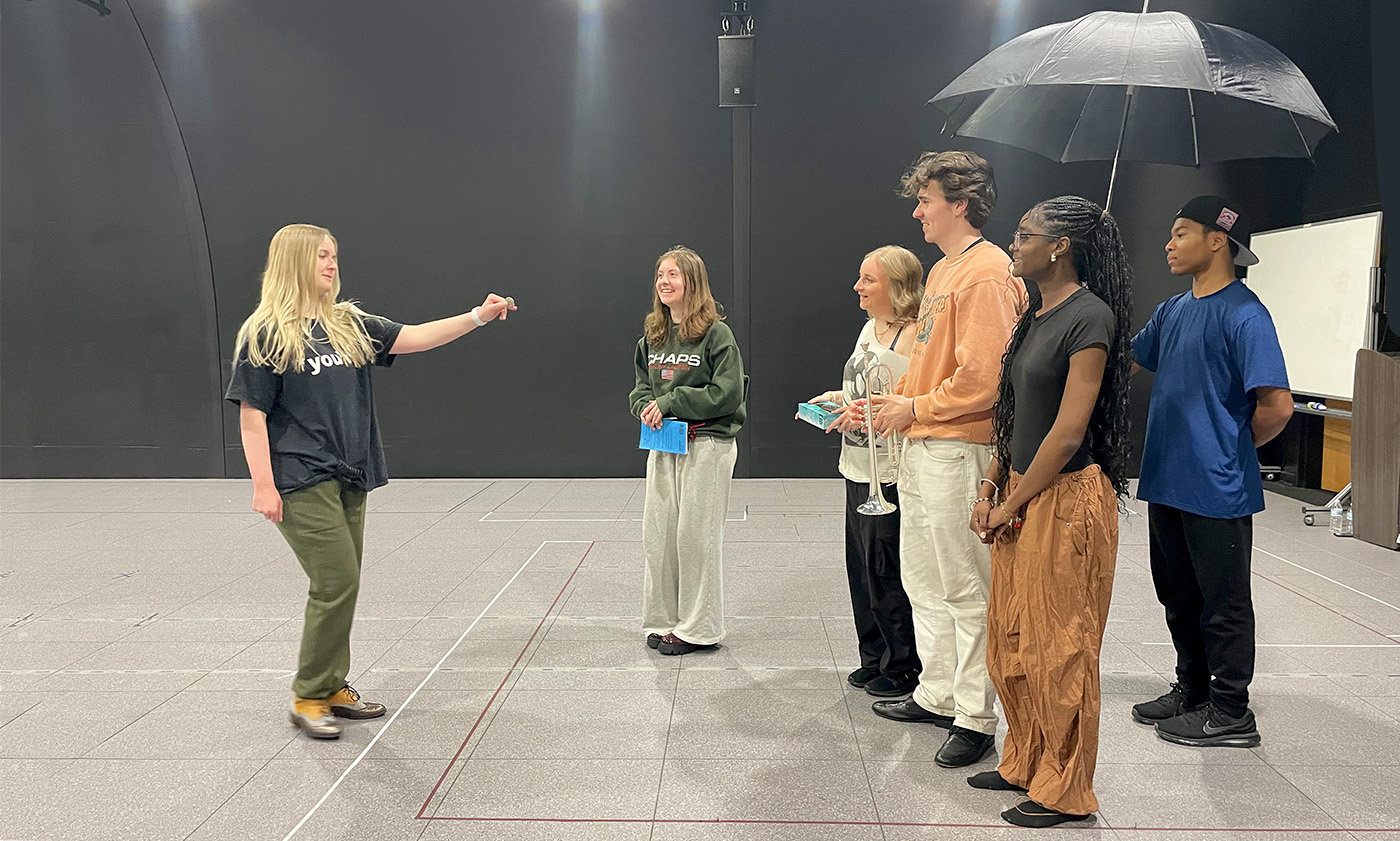
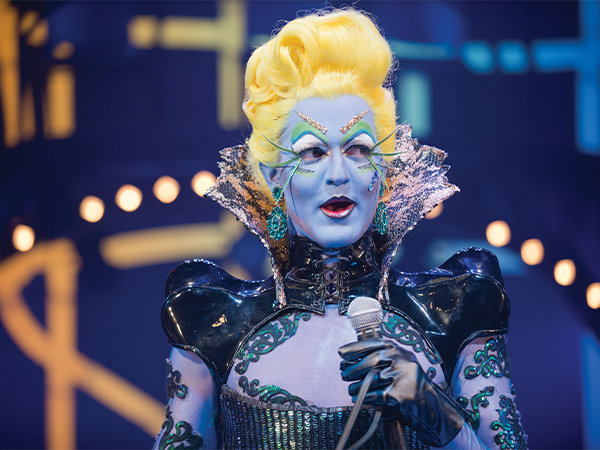
Director James Peck was looking for a little joy when he selected “Twelfth Night” for the culminating production of Muhlenberg College’s 2025-26 theater and dance season. The musical adaptation of Shakespeare’s gender-bending comedy offers all the heart and humor of the original, Peck says, overflowing with a spirit of community and celebration — just what he was looking for.
“Illyria is a kind of magic place, where extraordinary things happen,” says Peck, a professor of theater at the college. “I thought it would be a gift to the cast and to the community to work on a show where joy was the predominant experience.”
The adaptation was originally conceived by Kwame Kwei-Armah and Shaina Taub as part of the Public Theater’s Public Works Project. The project “seeks to create a space where we can not only reflect on the world as it is, but where we can propose new possibilities for what our society might be.” Blending some of Shakespeare’s original language with a compelling jazz-funk score by Taub, “Twelfth Night” runs April 23-26 on Muhlenberg’s Baker Theatre stage.
Muhlenberg theater alum Ashley Hiester ’19 has returned to serve as musical director for the production.
Making Shakespeare Accessible
Audiences who might be intimidated by Shakespeare’s work have nothing to fear, says dramaturg Sof Oberg ’26. The musical adaptation makes this tale of love and mistaken identity entirely approachable for modern audiences.
“We tend to think of Shakespeare as very ‘elitist.’ But when Shakespeare was writing these plays, they weren’t elitist at all,” Oberg says. “This show takes Shakespeare’s work down from its pedestal and makes it more accessible.”
“Twelfth Night” tells the story of Viola, a young heroine who washes up on the shores of Illyria — a bustling twenty-first century beach town in this staging. She disguises herself as a man, is sent to court a countess and falls hard for a Duke. As she navigates this strange and wonderful new land, she finds her true self and true love in the process.
Iris Jordan ’26, who plays Viola, agrees with Oberg’s assertion. “Shakespeare can be really difficult to understand, and that makes it inaccessible to some people,” she says. “I think that the way the musical has been adapted makes the story so clear without compromising Shakespeare’s intention.”
Jordan says the show brings a contemporary lens to Viola’s journey, as she navigates identity and gender. “Viola has to jump through all these hoops as an independent woman in Illyria,” she says. “There’s a lot of confronting the patriarchy and asking, ‘Why am I treated differently when I look like a man, versus when I look like a girl?’”
A Story of Connection
While the show is filled with comedy and romance, choreographer Noel Price-Bracey says that it also asks audiences to look beyond themselves. She cites the show’s closing number, “Eyes of Another,” which invites the audience to see the world around them from a different perspective.
“Maybe not just seeing through the eyes of another,” says Price-Bracey, a professor of dance at the college. “But what does it mean to transport your mindset into someone else’s experience, and really consider, ‘Man, what are they going through?’”
Price-Bracey’s choreography blends a range of movement styles, pulling from both traditional and contemporary forms to create something that feels layered and intentional. The influence of Black dance and the diaspora can be seen throughout the show, not just in specific movements, but in the way choreography carries history and cultural memory.
“It’s important to tell stories from this origin and showcase different diasporic dance styles now more than ever,” says Hanajah White-Wise ’26, an ensemble member and dance rehearsal assistant. “Black culture has influenced not only dance, but music as well. Honoring the moves and styles is something Jim and Noel want audiences to connect with and understand.”
Price-Bracey highlights the sense of connection that is reflected by the cast of diverse performers on stage. “I think ‘Twelfth Night’ is a true representation of our community,” she says. “There’s so much representation on stage. People could come to the show and see themselves in one of the characters.”
A Celebration of Community
Peck says that at its core, “Twelfth Night” is about bringing people together.
“In putting the company together, it was really important for us to have a very inclusive and visibly diverse sense of who the people are that are making the play happen,” he says. “It’s important to make something that has a spirit of inclusion, supporting the sense of love and belonging and togetherness that’s at the heart of what community means in the play.”
Oberg emphasizes the importance of inclusion. “That’s what theater is all about — community and working together.”
With a large and diverse cast, an energetic score, and a story filled with humor and passion, this show invites audiences into a world where everyone belongs and is celebrated. For one night in Illyria, love takes center stage.
“Love is the most powerful force in the world,” Peck says. “And the musical is a celebration of that truth. At the end of the day, the musical means ‘love wins.’ And it’s about as simple as that.”
“Twelfth Night” the musical plays April 23-26, in the Dorothy Hess Baker Theatre, Trexler Pavilion for Theatre and Dance at Muhlenberg College, 2400 Chew St., Allentown. Performances are Thursday through Saturday at 8 p.m. and Sunday at 2 p.m. Tickets are available at muhlenberg.edu/seeashow or 484-664-3333.